

How Does Coin-to-Card Conversion in Arcade Venues Work? A Complete Modernization Guide
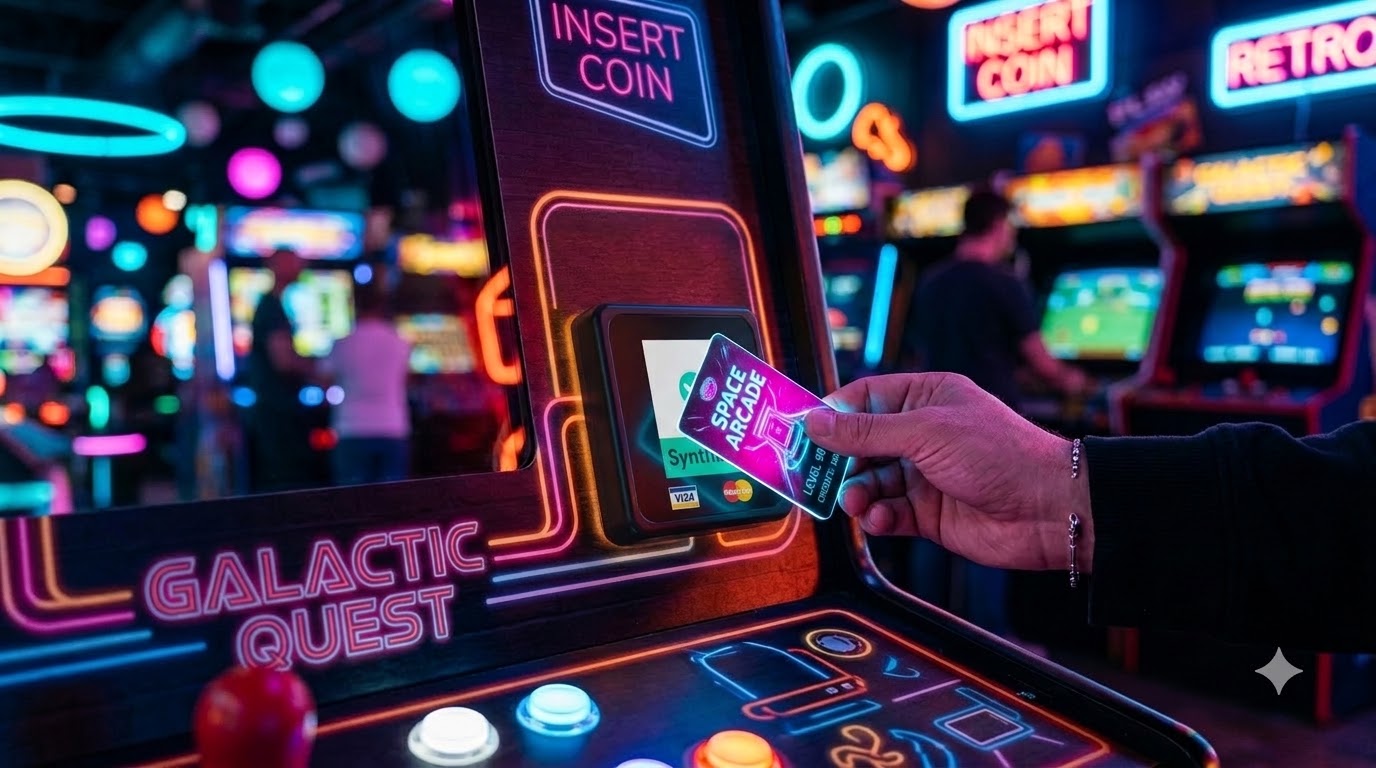
The nostalgic sound of dropping quarters or tokens into an arcade cabinet brings back great memories, but running an entertainment venue on loose change today creates bottlenecks, operational drag, and lost revenue. Modern entertainment centers, bars, and retro arcades are rapidly shifting toward tap-and-play card systems to streamline operations and boost profitability.
If you are wondering how coin-to-card conversion in arcade environments works, here is the short answer:
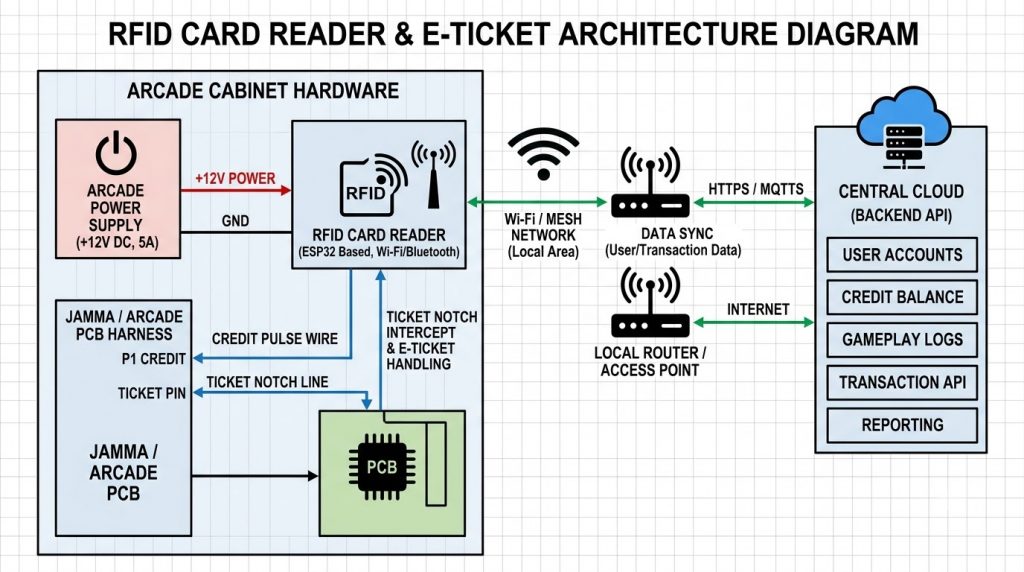
Quick Answer: Coin-to-card conversion in arcade machines interfaces traditional physical coin comparators (coin mechs) and token hoppers with RFID/NFC or magnetic stripe card readers. These readers connect directly to the cabinet’s existing credit input harness (pulse or serial lines). When a player taps their card, the reader deducts credits from a cloud or local server balance and sends an electronic pulse that mimics a physical coin drop, immediately starting the game.
Note that your arcade machine will still have the physical coin comparators (coin mechs) and token hoppers. A card reader is just a addition to your machines.
This guide explores the mechanics behind upgrading your machines, why upgrading legacy cabinets is critical for profitability, and how modern turnkey solutions like SynthiaX simplify the transition.
Why Should You Add a Card Reader?
Before breaking down the technical retrofit process, operators must understand the business case for replacing tokens and coins. Transitioning to a cashless environment delivers measurable returns across revenue, player engagement, and operational efficiency.
1. Significant Revenue Uplift
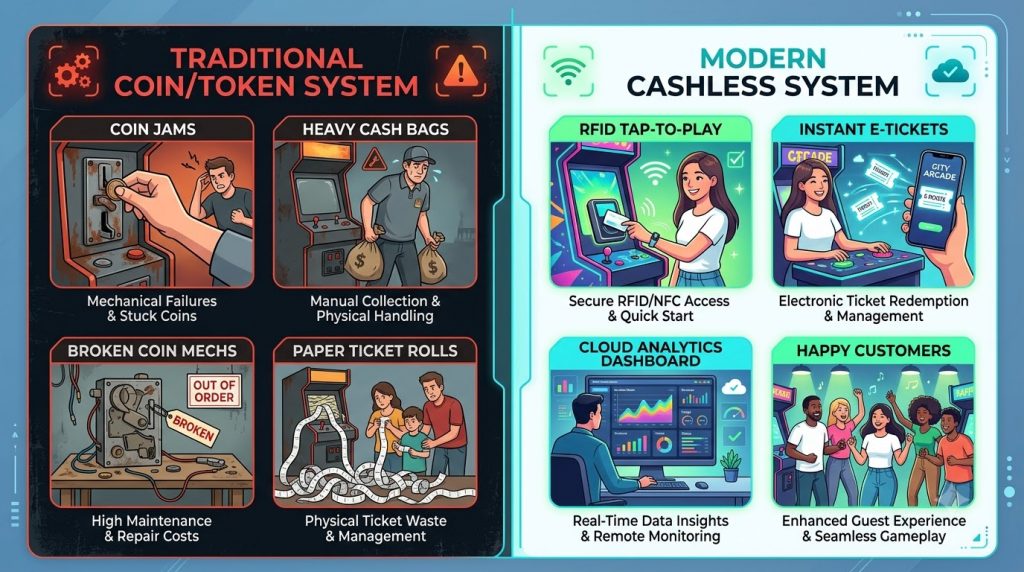
Cashless players spend significantly more per visit than cash-only players. Frictionless microtransactions remove psychological spending limits. Instead of digging into their pockets for another bill or token, guests simply tap their card. Furthermore, cashless platforms allow you to implement dynamic pricing (such as happy hour discounts or premium weekend rates) and tiered bonus bundles (e.g., “Spend $25, get $30 in credits”), instantly driving higher average transaction values.
2. Elimination of Mechanical Jams and Maintenance
Mechanical coin comparators, token chutes, and coin hoppers are notorious points of failure. Dust, bent coins, foreign objects, and wear-and-tear lead to coin jams, putting high-earning machines out of service during peak operational hours. A coin-to-card conversion in arcade cabinets eliminates moving mechanical coin parts, drastically reducing downtime and cutting maintenance callouts.
3. Lower Labor Overhead and Better Security
Collecting, counting, sorting, and hauling heavy bags of coins or tokens consumes hours of staff labor each week. Cash in cabinets also creates vulnerabilities to internal shrink and external theft. Converting to card readers centralizes all revenue into digital transactions, providing automated bookkeeping, real-time telemetry, and reduced manual labor.
4. Digital Ticket Management (E-Tickets)
Card systems do not just replace coin inputs; they also replace physical ticket dispensers. By routing redemption payouts directly to the player’s digital balance as e-tickets, you eliminate ticket paper costs, remove paper-jam headaches, and keep game lines moving quickly.
How Does Coin-to-Card Conversion in Arcade Machines Work?
Transitioning older, coin-operated cabinets to a modern cashless ecosystem does not require discarding your favorite classic titles. The architecture of arcade boards, from vintage 1980s JAMMA cabinets to modern raw-thrills platforms, is inherently modular.
Below is the step-by-step breakdown of how coin-to-card conversion in arcade machines is implemented on a hardware and software level.
Step 1: Evaluating the Cabinet Wiring and Interface Standards
Every arcade machine registers credits when a circuit closes on its coin switch line. In traditional setups, a microswitch or optical sensor trips when a coin drops through the mech, sending an active-low or active-high electrical pulse to the game’s logic board (PCB).
During a coin-to-card conversion in arcade setups, technicians identify:
- Power Delivery: Most modern card readers operate on +12V DC or +5V DC, which can be tapped directly from the arcade cabinet’s switching power supply.
- Credit Signal Line (Coin 1 / Coin 2): The reader connects directly to the cabinet’s existing coin signal pin on the wiring harness (e.g., Pin 16 on a standard 56-pin JAMMA harness).
- Ticket/Redemption Line: On redemption machines, the ticket notch signal line is spliced so the card reader catches and counts redemption pulses digitally instead of feeding paper tickets.
Step 2: Mechanical Retrofitting and Faceplate Mounting
The physical installation requires replacing or modifying the coin door:
- Direct Mech Replacement: Many card readers match standard single-slot coin mech form factors. The technician unbolts the mechanical coin entry bezel and replaces it with the card reader faceplate.
- Surface Mounting: If retaining coin functionality as a fallback is desired, operators can mount the card reader housing directly above the coin door on the wooden or metal cabinet chassis using custom brackets.
- Display and Feedback Integration: The card reader display (often an illuminated LCD or OLED screen with multicolor LEDs) is positioned at eye level so players can check credit balances, play prices, and game instructions instantly.
Step 3: Configuring Pulse Width and Signal Emulation
Arcade logic boards interpret game credits based on pulse timing (measured in milliseconds). If a pulse is too short, the game ignores it; if it is too long, it may register as a switch error.
Modern readers allow technicians to calibrate the following parameters:
- Pulse Width: Setting the high/low duration (e.g., 50ms pulse / 50ms pause) to match the timing expected by legacy titles like Pac-Man, Galaga, or Street Fighter II.
- Credit-to-Pulse Ratio: Operators can set how many digital cents or card points equal one pulse. For instance, if an arcade game costs $1.00 and was originally wired for $0.25 coins, the card reader is programmed to send four rapid pulses upon a single tap.
Step 4: Connecting to the Central Server and Point-of-Sale (POS)
For the card reader to verify balances, it communicates with the venue’s local controller or cloud management platform via Wi-Fi, Ethernet, or a dedicated RS-485 mesh network.
When deploying an integrated platform like SynthiaX, the system coordinates these components:
- Self-Service Kiosks: Guests buy or reload RFID cards using credit/debit cards, cash, or mobile wallets (Apple Pay / Google Pay).
- Card Reader Telemetry: As the card taps the machine, the reader queries the SynthiaX backend to check balance validity.
- Transaction Execution: The server updates the user balance in real-time and logs the play data to the manager dashboard.
Technical Comparison: Cash/Token System vs. Cashless System
To see the direct impact of completing a coin-to-card conversion in arcade setups, review the operational differences:
| Feature / Metric | Traditional Coin/Token System | Modern Cashless Card System |
| Payment Options | Cash / Physical Tokens only | RFID Cards, Mobile Wallets, Credit/Debit |
| Pricing Flexibility | Fixed (multiples of $0.25 / 1 token) | Fully dynamic (e.g., $1.35, VIP discounts, happy hours) |
| Redemption Management | Paper tickets requiring refills & inventory | 100% digital e-tickets stored on player accounts |
| Mechanical Downtime | High (frequent jams, bent tokens, dirty mechs) | Near zero (solid-state electronics, no moving parts) |
| Revenue Tracking | Manual meter reads, risk of internal shrinkage | Real-time automated cloud analytics & reporting |
| Customer Retention | Low (tokens left behind are rarely tracked) | High (loyalty rewards, registered member perks) |
Case Study: Modernizing “Neon Heights Arcade & Bar”
To understand the real-world impact of completing a coin-to-card conversion in arcade spaces, let’s examine a mid-sized venue retrofit.
The Challenge
Neon Heights operates 48 retro arcade cabinets, 12 pinball machines, and 8 redemption games. The venue relied entirely on quarter changers and physical brass tokens.
- The operator spent roughly 16 hours per week unjamming mechs, emptying coin hoppers, counting cash, and restocking paper tickets.
- During peak Friday and Saturday nights, popular machines went offline due to coin jams before staff could address them.
- Fixed token pricing limited profitability as operational and maintenance costs rose.
The Solution: Deploying SynthiaX Cashless Infrastructure
The venue executed a complete coin-to-card conversion in arcade machines across all 68 games using SynthiaX card readers and a centralized self-service kiosk:
- Plug-and-Play Retrofit: Technicians wired SynthiaX multi-frequency RFID readers directly into the coin switches and power rails of all 68 cabinets within two days.
- Digital E-Tickets: The redemption machines were configured to award digital tickets directly to player cards, completely replacing paper ticket stock.
- Dynamic Pricing Strategy: The operator raised pricing on high-demand premium cabinets from $1.00 (4 tokens) to $1.50 during weekend peak hours, while introducing half-price game nights on Tuesdays.
The Measurable Results
Within 90 days of completing the coin-to-card conversion in arcade systems:
- Revenue Growth: Overall gross revenue jumped by 34.8%, driven primarily by higher average spend per customer and dynamic weekend pricing.
- Labor Savings: Eliminating coin counting, vault drops, and paper ticket reloading freed up 16 hours of weekly labor, allowing staff to focus entirely on customer service and bar sales.
- Eliminated Downtime: Machine downtime dropped by over 95%, maximizing uptime across peak weekend revenue hours.
- ROI Realization: The entire hardware and software installation paid for itself in just 4.2 months.
Key Considerations Before Starting Your Conversion
When planning a coin-to-card conversion in arcade cabinets, keep the following best practices in mind:
1. Maintain Network Redundancy
Your cashless readers require dependable network communication to verify transactions. Ensure your venue has robust Wi-Fi coverage or hardwired sub-controllers so offline modes can buffer transactions if the internet connection temporarily drops.
2. Dual-Mech Options for Classic Pinball & Antiques
For exceptionally rare, antique, or mechanical electromechanical (EM) pinball machines where you wish to preserve the authentic coin experience, consider installing dual-interface setups. This keeps the physical coin mech operational alongside the card reader, giving purists the option to drop physical quarters while offering modern guests the convenience of tap-to-play.
3. Clear Onboarding for Guests
When transitioning your venue, provide visible signage near the entrance and around automated kiosks. Introduce introductory perks, such as “Buy $20, Get $5 Free in Bonus Plays”, to encourage customers to register their cards and embrace the new system from day one.
Frequently Asked Questions (FAQ)
1. Does a coin-to-card conversion in arcade machines damage vintage boards?
No. Card readers simulate the standard electronic pulse that the original coin microswitch creates. Because the reader only acts as a low-voltage switch closure, it does not alter the core ROM, logic chips, or board architecture of classic arcade hardware.
2. Can card readers handle redemption games that dispense physical tickets?
Yes. Modern card readers can be wired to intercept the cabinet’s ticket notch signal. Instead of pulsing the mechanical ticket dispenser motor, the reader intercepts those pulses, logs them as e-tickets, and updates the player’s account balance digitally.
3. What power supply do cashless card readers require?
Most arcade card readers require a standard +12V DC (or +5V DC) connection at 200mA to 500mA. In almost all arcade cabinets, this power is tapped directly from the existing switching power supply already running the cabinet’s monitor, audio, and game boards.
4. How long does it take to convert a single arcade cabinet?
With standard wiring harnesses (such as JAMMA), converting a single machine takes between 15 to 30 minutes. Custom non-standard cabinets or complex multi-player games may take 45 to 60 minutes to mount hardware and configure pulse timings.
5. Can players still use cash at the venue?
Yes. Although the game cabinets themselves become cashless, guests can use cash at self-service payment kiosks to purchase or reload their RFID game cards. This ensures you accommodate both cash-carrying guests and mobile/card payment users.
Ready to Upgrade Your Arcade?
Sticking with mechanical coins and paper tickets limits your revenue, increases equipment downtime, and wastes valuable staff labor. Completing a coin-to-card conversion in arcade systems modernizes your floor, protects your revenue with real-time analytics, and creates a seamless player experience that keeps guests returning.