

How Long Does It Take to Install an Arcade Card System? (Complete Guide)
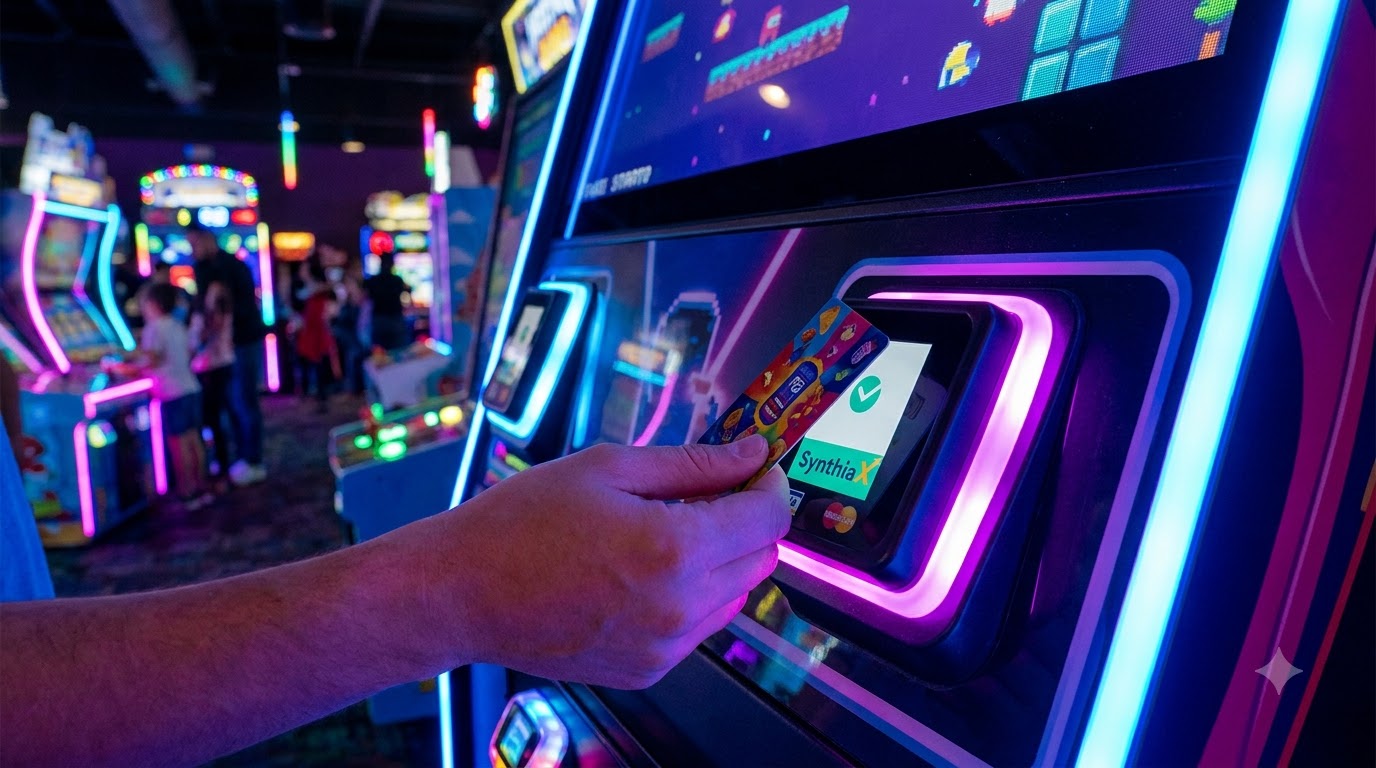
Upgrading your entertainment venue from traditional coins or tokens to a cashless payment platform is one of the most profitable decisions you can make. If you plan to make the switch, you probably have one pressing operational question: how long does it take to install an arcade card system?
To fit a single machine with a Plug-and-play system like SynthiaX it takes less then 10 miniutes to install. For a typical small to mid-sized arcade with 20 to 60 machines, installing a complete arcade card system takes between 1 to 3 days. Larger family entertainment centers (FECs) with 100 or more arcade cabinets, redemption counters, and integrated POS terminals generally require 4 to 7 business days. With pre-configured hardware and modern plug-and-play architecture from solutions like SynthiaX, operators can often complete the hardware and software deployment over a single weekend with zero daytime disruption.
This comprehensive guide breaks down the full installation process, the timeline variables, the step-by-step setup procedure, and why switching to a modern arcade card system delivers massive returns on your investment.
Why You Should Add an Arcade Card System to Your Arcade
The traditional coin-operated model creates friction for both players and arcade operators. Physical coins jam mechanisms, require daily manual coin drops, invite internal shrinkage, and limit your pricing flexibility. Switching to an arcade card system removes these bottlenecks and unlocks modern operational advantages.
1. Substantial Revenue Growth
When players do not have to count physical quarters or dollar bills, their spending velocity increases. Card-based game rooms regularly see a 20% to 35% jump in gross revenue immediately after deploying an arcade card system. Players load money onto tap-to-play RFID cards or digital wallets, detaching the perceived psychological cost from every individual play.
2. Flexible and Dynamic Pricing
Mechanical coin slots restrict your pricing strategy to whole increments of quarters or tokens. An arcade card system allows you to charge exact fractional amounts, such as $1.15, $1.60, or $2.85 per play. You can also run automated happy-hour promotions, half-price VIP nights, or peak-hour pricing rules with a few clicks in your management dashboard.
3. Elimination of Coin Jams and Mechanical Maintenance
Mechanical coin comparators and ticket dispensers break down constantly. Staff members waste hours unjamming coin chutes, refilling physical paper tickets, and balancing cash hoppers. An arcade card system replaces physical ticket dispensers with digital e-tickets stored directly on customer accounts, reducing machine downtime and cutting maintenance expenses.
4. Robust Real-Time Analytics and Shrinkage Protection
Physical cash boxes present security risks and accounting challenges. A cloud-connected arcade card system tracks every tap, card swipe, payout, and credit balance across your facility. Platforms like SynthiaX provide operators with live telemetry, automated payout audits, and predictive game diagnostics right from their smartphones.
How Long Does It Take to Install an Arcade Card System?
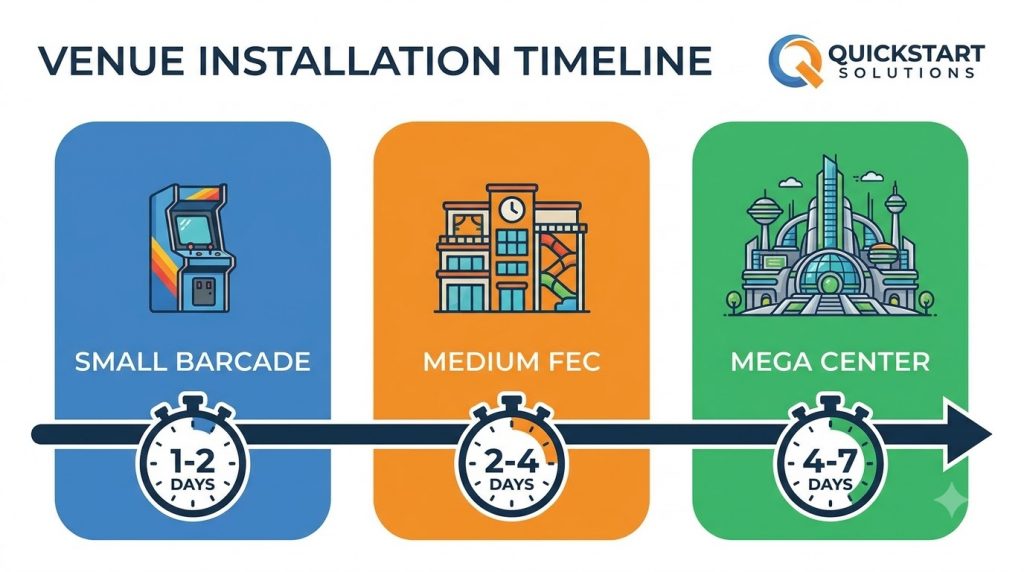
The overall timeline depends on venue scale, cabling infrastructure, cabinet age, and network readiness. Below is an overview of what to expect based on your facility size.
1. Small Arcades and Barcades (15 to 40 Machines)
- Average Time: 1 to 2 days
- Staff Needed: 1 to 2 technicians
- Scope: Installing card readers directly into standard coin door knockouts, connecting readers to local power harnesses, testing pulse lines, and setting up one self-service revalue kiosk alongside a front POS terminal.
2. Mid-Sized Family Entertainment Centers (50 to 100 Machines)
- Average Time: 2 to 4 days
- Staff Needed: 2 to 3 technicians
- Scope: Installing readers on a mixed floor of redemption games, claw machines, driving simulators, and pinball tables. This timeline includes running Wi-Fi access points or Ethernet drops, configuring redemption counter barcode scanners, setting up digital prize inventory, and training floor staff.
3. Large Multi-Attraction Venues (100+ Machines)
- Average Time: 4 to 7 days
- Staff Needed: 3 to 4 technicians and an IT network specialist
- Scope: Equipping complex virtual reality stations, laser tag briefing rooms, bowling lanes, and full-floor game cabinets with card readers. It also involves setting up multiple self-service payment kiosks, cloud server synchronizations, and deep staff training.
Key Factors That Influence Your Installation Timeline
Several variables dictate whether your arcade card system installation takes 24 hours or an entire week. Planning for these factors in advance keeps your downtime to a minimum.
Network and Cabling Infrastructure
Card readers communicate with your server using either hardwired RS-485/Ethernet cables or wireless protocols like Wi-Fi and mesh RFID networks.
- Wireless Networks: Greatly speed up installation because technicians do not need to pull low-voltage cables across ceilings or through floor trenches.
- Wired Networks: Require more upfront installation time, but they offer rock-solid reliability in venues with severe radio frequency interference.
Machine Variety and Cabinet Vintage
Modern raw arcade machines come equipped with standard auxiliary power ports and standard coin meter harnesses. Retro arcade games, electromechanical pinball cabinets, and imported specialty Japanese rhythm games often require custom wiring harnesses or voltage step-down converters. A venue with uniform, modern raw cabinets installs twice as fast as an eclectic retro arcade.
Pre-Configuration of Hardware
If your vendor ships raw, unconfigured readers, your technicians must manually flash firmware, map machine IDs, and assign pulse values on site. In contrast, choosing an agile provider like SynthiaX ensures your readers, kiosks, and server gateways arrive pre-addressed, labeled, and bench-tested before delivery. Pre-configured systems cut on-site labor time by up to 50%.
Step-by-Step: How to Add an Arcade Card System to Your Venue
Installing a modern arcade card system follows an organized, repeatable workflow. Following this five-phase roadmap ensures your venue transitions smoothly without lost operating hours.
+------------------------------------------------------------------+
  |              5-PHASE INSTALLATION WORKFLOW                       |
  +------------------------------------------------------------------+
  |  Phase 1: Pre-Install Audit & Network Survey                     |
  |                            |                                     |
  |  Phase 2: Network, Server & Kiosk Setup                          |
  |                            |                                     |
  |  Phase 3: Hardware Mounting & Reader Harnessing                  |
  |                            |                                     |
  |  Phase 4: Software Configuration & Pricing Logic                 |
  |                            |                                     |
  |  Phase 5: Quality Testing & Staff Onboarding                     |
  +------------------------------------------------------------------+
Phase 1: Pre-Installation Audit and Site Planning (Time: 2 to 5 Days Prior)
Before opening a single toolbox, conduct a comprehensive audit of every game on your floor.
- Document the coin input voltage (12V DC, 5V DC, or dry contact pulse) for every cabinet.
- Note whether each game uses standard 0.75-inch mounting holes or requires custom faceplates.
- Conduct a wireless signal survey across your game floor to identify Wi-Fi dead zones.
- Prepare your prize inventory database with point values for the redemption counter.
Phase 2: Core Network, Server, and Kiosk Deployment (Time: 4 to 8 Hours)
Once the audit is complete, your team installs the core infrastructure:
- Mount enterprise-grade Wi-Fi access points or run dedicated network switches to your game clusters.
- Install the central server gateway or establish the encrypted cloud link.
- Position and power on the self-service reload kiosks.
- Connect the front-desk POS terminals, RFID card issuing encoders, and redemption barcode scanners.
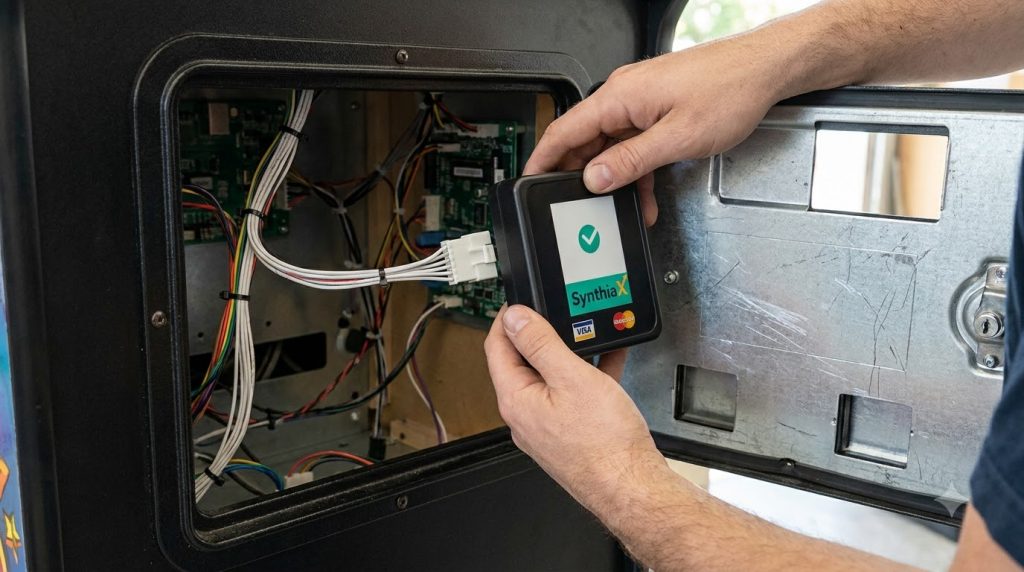
Phase 3: Reader Mounting and Physical Harnessing (Time: 15 to 25 Minutes Per Machine)
This phase represents the core physical labor of adding an arcade card system:
- Power down the arcade cabinet.
- Remove the old mechanical coin acceptor or bypass the token mechanism.
- Mount the card reader onto the door faceplate using security fasteners.
- Connect the reader harness to the game power supply and the coin switch trigger line.
- If the game awards physical tickets, connect the electronic ticket emulator to log digital e-tickets directly to player cards.
- Power on the machine and confirm reader initialization.
Phase 4: Software Mapping and Game Configuration (Time: 2 to 4 Hours)
After the readers are live, configure your game profiles through the software management console:
- Assign unique machine IDs, game names, and floor locations to each reader.
- Set credit costs per play, pulse duration, and game play timings.
- Establish e-ticket payout multipliers for redemption games.
- Set up promotional schedules, membership loyalty tiers, and automated daily discounts.
Phase 5: Calibration, Testing, and Staff Training (Time: 4 to 8 Hours)
Before unlocking the doors to the public:
- Tap test cards on every game to ensure the correct credits trigger accurately.
- Play redemption games to confirm e-tickets deposit onto the customer balance without dropouts.
- Test cash and credit card transactions on all self-service kiosks.
- Train your floor attendants on issuing cards, looking up account histories, and handling prize redemptions.
Comparison: Arcade With Card Reader vs. Without Card Reader
Operating an arcade with an automated arcade card system delivers distinct operational advantages over manual coin or token setups. The table below details the performance differences.
| Feature / Metric | Without Card Reader (Coins/Tokens) | With Arcade Card System (Cashless) |
| Average Installation Effort | Built into machine purchase | 1 to 3 days for complete retrofitting |
| Average Customer Spend | Limited by cash on hand ($10 to $15/visit) | 25% to 35% higher ($20 to $35/visit) |
| Pricing Flexibility | Increments of $0.25 tokens only | Any custom amount (e.g., $1.35, $2.10) |
| Ticket Handling | Physical paper tickets (frequent jams & refills) | Digital e-tickets stored on cards automatically |
| Daily Labor Requirements | 1 to 3 hours daily for coin drops and ticket refilling | Zero manual coin counts; automated digital reporting |
| Machine Downtime | High (mechanical coin switch jams, ticket jams) | Minimal (solid-state electronics, tap-to-pay) |
| Promotions & VIP Tiers | Difficult to execute without custom token designs | Instant cloud-based happy hours, bonuses, loyalty rules |
| Loss & Theft Prevention | Vulnerable to physical break-ins and skimming | 100% digital audit trails with encrypted payments |
| Analytics & Data | Manual estimation based on meter readings | Real-time game telemetry, popularity heatmaps, payouts |
How SynthiaX Streamlines Arcade Card System Installation
Choosing the right technology partner is the single most important factor in keeping your arcade card system deployment on schedule. SynthiaX is an all-in-one amusement management platform designed specifically to eliminate traditional installation bottlenecks.
Here is how SynthiaX reduces installation time and boosts operational revenue:
- Pre-Mapped Plug-and-Play Hardware: Every reader arrives pre-programmed for your specific machine lineup. Technicians plug the harness in, mount the reader, and the unit connects to the cloud instantly.
- Universal Harness Compatibility: Whether you operate modern Japanese rhythm games, classic 80s arcade cabinets, or complex prize cranes, SynthiaX provides universal adapter cables that remove the need for custom soldering.
- Cloud-First Scalability: You do not need to install complex local servers or maintain on-site databases. The intuitive cloud dashboard lets you manage pricing, run prize audits, and analyze revenue from any laptop or mobile device.
- Resilient Hybrid Offline Protocol: Even if your venue internet connection drops, the readers continue processing guest gameplay and storing ticket balances locally without interrupting customer fun.
Frequently Asked Questions About Arcade Card System Installation
Can I install an arcade card system on vintage retro arcade cabinets?
Yes. Modern card readers can interface with almost any classic machine built over the last 40 years. Because retro games rely on simple mechanical ground pulses to register credits, you only need to tap into the coin switch line and supply 12V DC power to the reader.
Will my arcade have to close down during the installation?
No. Most operators schedule reader installations during normal off-hours, such as Monday and Tuesday mornings. Alternatively, technicians can work in rolling sections across the room, retrofitting clusters of 10 to 15 games at a time while the rest of your facility stays open to guests.
Do card readers require wired Ethernet cables to every machine?
Not necessarily. Modern platforms utilize reliable Wi-Fi or local mesh networks to communicate with your central server. Hardwired connections remain an option for high-density layouts, but wireless readers significantly speed up installation and simplify future floor plan rearrangements.
What happens to the physical ticket dispensers during installation?
Technicians disconnect the physical ticket dispensers and attach an electronic ticket emulator directly into the machine ticket signal line. When a player wins points, the cabinet sends ticket pulses to the card reader, which deposits digital e-tickets directly to the player account. If you still want to keep the physical system you can keep it along side the digital one.
How quickly does an arcade card system pay for itself?
Most operators recover their total hardware and installation investment within 3 to 9 months. The combination of higher guest spending, dynamic pricing options, eliminated ticket costs, and drastically reduced labor drives immediate profit margin expansion.
Do I need to remove of coin mechanism completely to use a card reader?
No, You don’t need to remove your coin reader or coin mechanism to use an arcade card system. To install the card reader you will have to remove it but once installed it works along side your regular Coin mechanism to increase your sales. With SynthiaX a separate mount is provided to you in order to mount it to your machine.
Upgrade Your Venue with a Modern Arcade Card System Today
Upgrading your game room does not have to mean weeks of downtime, complicated wiring, or lost business. With modern hardware design and pre-configured components, you can install an arcade card system in as little as 24 to 72 hours.
If you are ready to eliminate coin jams, increase customer spend by over 30%, and automate your game operations, explore what SynthiaX can do for your business.