

How Do Credit Card Readers on Vending Machines Work? A Complete Guide to Card Readers for Vending Machines
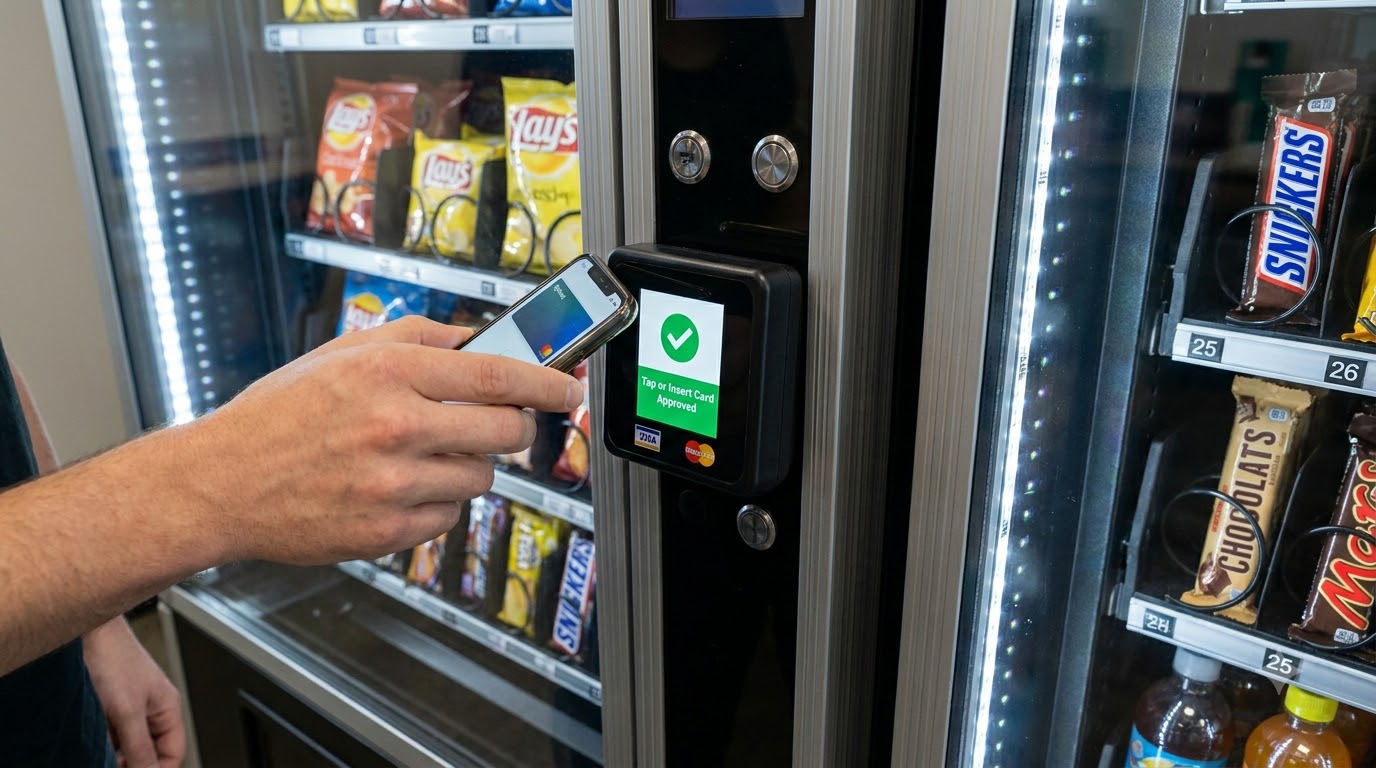
Have you ever wondered what happens behind the screen when you tap your debit card on a snack machine?
Quick Answer: Card readers on vending machines capture payment details through tap (NFC), chip (EMV), or magnetic swipe, encrypt the data, and send it wirelessly across cellular networks to a payment processor. Once the bank approves the charge, the payment terminal communicates with the internal Vending Machine Controller (VMC) using the standard Multi-Drop Bus (MDB) protocol to release your selected product. The entire transaction takes less than three seconds.
Modern vending operations depend on cashless convenience. As consumers carry less physical currency, operators who install card readers for vending machines capture more sales, minimize machine downtime, and streamline daily management.
This comprehensive guide explores the inner workings of cashless vending hardware, outlines why upgrading your fleet matters and answers common operational questions.
Why Should You Install Card Readers for Vending Machines?
Consumer behavior has shifted dramatically toward digital payments. Coins and bills are no longer the primary currency for impulse snack and beverage purchases. Equipping your unattended retail units with card readers for vending machines delivers measurable business advantages.
1. Significant Revenue Growth and Higher Spend
Cash purchases create psychological friction. When shoppers must search their pockets for exact change, they often abandon the purchase entirely. Installing card readers for vending machines removes this hurdle. Customers can make rapid impulse purchases using credit cards, debit cards, Apple Pay, Google Wallet, or prepaid campus cards.
Furthermore, cashless devices support multi-vend transactions. Rather than limiting purchases to a single dollar bill, customers routinely buy multiple snacks and drinks in one session, raising your average ticket price by 25% to 40%.
2. Elimination of Cash Handling and Operational Costs
Managing cash in vending machines demands considerable labor and risk:
- Drivers must carry coin bags and count bills manually.
- Bill validators jam when consumers insert wrinkled or wet banknotes.
- Coin mechanisms run out of change, resulting in lost sales.
- Physical cash inside machines attracts vandalism and employee theft.
By deploying card readers for vending machines, you reduce cash collection visits, decrease wear on mechanical coin tubes, and secure your revenue directly into your bank account.
3. Real-Time Telemetry and Remote Inventory Management
Modern card readers for vending machines double as smart telemetry gateways. These devices do far more than process payments. They track inventory levels, monitor interior temperatures, report mechanical errors, and alert you when stock runs low. Instead of driving blind to restock a location, your technicians arrive with the exact items required.
How Card Readers for Vending Machines Work: Step-by-Step
Understanding the hardware and software pipeline behind card readers for vending machines helps operators troubleshoot errors, optimize transaction speed, and choose the right equipment.
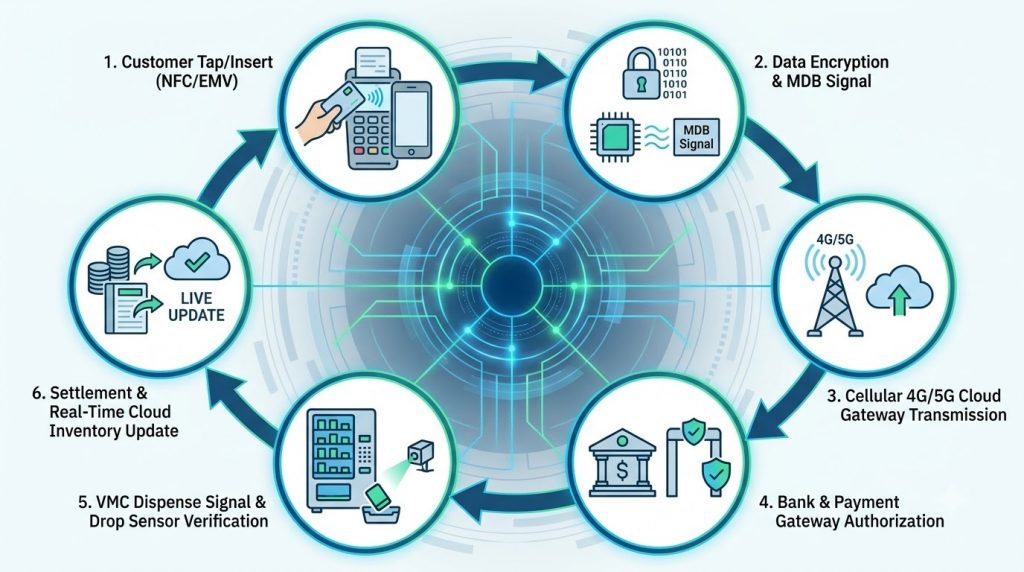
Step 1: Payment Capture and Data Encryption
The transaction starts when a customer interacts with the cashless reader. Modern card readers for vending machines accept three primary input formats:
- Near Field Communication (NFC): Contactless cards, smartphones, smartwatches, and RFID tags communicate via short-range radio frequencies (13.56 MHz).
- EMV Chip (Europay, Mastercard, Visa): The microchip creates a unique, one-time transaction code that prevents cloned card fraud.
- Magnetic Stripe: The reader scans the magnetic track on older payment cards.
Immediately upon reading the account data, the hardware encrypts the payload using point-to-point encryption (P2PE) and tokenization. The card reader never stores raw debit or credit card numbers locally on the machine.
Step 2: The Multi-Drop Bus (MDB) Communication
The card reader interface connects directly to the machine’s central computer, known as the Vending Machine Controller (VMC). This connection relies on an internal industry standard called the Multi-Drop Bus (MDB) protocol.
When a customer taps their card:
- The card reader sends an MDB signal to the VMC stating that credit is pending.
- The VMC illuminates the front display and prompts the customer to make a selection.
- The customer presses the keypad (for example, row B4).
- The VMC communicates the exact price of selection B4 back to the payment reader.
Step 3: Wireless Telemetry and Gateway Routing
Unlike retail point-of-sale systems that plug directly into fixed Ethernet cables, card readers for vending machines operate primarily over cellular IoT (Internet of Things) modems.
The integrated telemetry module packages the encrypted purchase amount and card token, sending the data over secure 4G LTE or 5G cellular networks to the payment gateway. The reader selects the strongest available network to maintain an uninterrupted connection even in basements, parking garages, or breakrooms.
Step 4: Authorization by the Payment Processor
The payment gateway routes the transaction to the merchant acquiring bank and the card network (Visa, Mastercard, American Express, or Discover).
Within hundreds of milliseconds:
- The cardholder’s bank verifies sufficient funds or available credit.
- Anti-fraud algorithms evaluate the transaction risk.
- An authorization approval code travels back through the cellular network to the vending machine terminal.
Step 5: Dispense Command and Motor Activation
Once the payment terminal receives the authorization code:
- It sends an MDB “Vend Approved” pulse to the VMC.
- The VMC engages the spiral motor, conveyor, or robotic arm corresponding to the chosen slot.
- Optical drop sensors at the bottom of the machine confirm that the product broke the infrared beam and landed safely in the retrieval bin.
- If the item fails to drop, the VMC cancels the charge, ensuring the consumer is never billed for a stuck product.
Step 6: Transaction Settlement and Telemetry Logging
After the vend cycle finishes, the payment processor groups all approved daily transactions into an automated batch for overnight deposit into your commercial bank account. Simultaneously, the telemetry software updates your cloud dashboard with current sales figures, cash-to-card ratios, and remaining inventory counts.
Evaluating Top Payment Hardware: SynthiaX vs. Nayax vs. Cantaloupe
Choosing the best card readers for vending machines impacts your margins, hardware reliability, and customer satisfaction. While established brands like Nayax and Cantaloupe offer dependable legacy ecosystems, SynthiaX has emerged as the premier next-generation solution for operators seeking lower processing overhead, rapid transaction response, and intuitive telemetry.
Below is an objective comparison of the top market contenders:
| Feature / Metric | SynthiaX Cashless Terminal | Nayax VPOS Touch | Cantaloupe ePort G10-S |
| Primary Connection | Ultra-Fast 4G/5G Multi-Carrier IoT | 4G LTE / Mesh Wi-Fi | 4G LTE Single/Dual Carrier |
| Transaction Latency | Under 1.5 Seconds | 2.0 to 3.5 Seconds | 2.5 to 4.0 Seconds |
| Supported Protocols | MDB, DEX, Pulse, Executive | MDB, DEX, Pulse | MDB, DEX |
| Display Interface | High-Res Color Touchscreen + Video | Color Touchscreen | Monochromatic / Basic Color LCD |
| Remote Telemetry | Included Native Cloud Suite | Nayax Core (Management Suite) | Seed Platform Integration |
| Processing Fee Flexibility | Competitive Operator-First Rates | Standard Interchange + Fixed Fee | Standard Fixed + Percentage Tier |
| Consumer Experience | Dynamic Prompts & Digital Receipts | Static Graphical Interface | Basic Text Display Prompts |
| Installation Complexity | Plug-and-Play Quick Harness | Standard Bracket Assembly | Standard Door Mount Harness |
Why SynthiaX Stands Out as the Premier Choice
Many operators struggle with sluggish connection speeds and confusing monthly administrative fees on legacy terminals. SynthiaX solves these pain points directly.
By utilizing lightning-fast multi-network IoT modems, SynthiaX processes tap-and-go transactions in under 1.5 seconds, drastically shortening customer lines in busy transit hubs, universities, and factory breakrooms.
Moreover, the SynthiaX platform integrates clean, transparent reporting tools that track machine performance without the confusing fee structures common to legacy providers. It serves as an all-in-one upgrade for modernizing older vending fleets.
Technical Architecture of Modern Card Readers
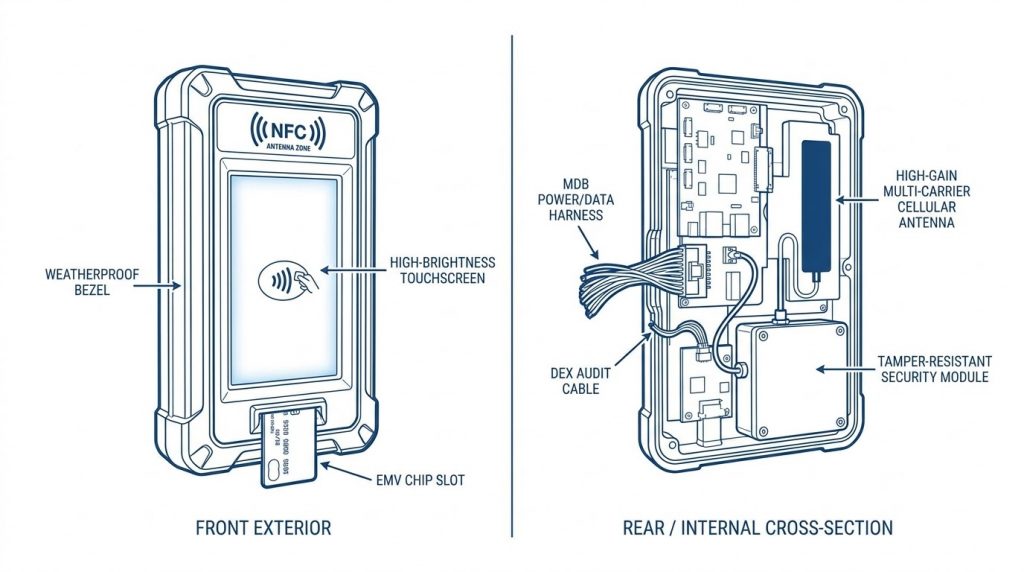
To appreciate why card readers for vending machines perform reliably in demanding environments, consider their fundamental hardware components:
- Weatherproof Outer Housing: The front bezel resists water ingress, temperature extremes (-20°C to 65°C), and physical vandalism.
- Integrated Antenna Array: High-gain antennas maintain a steady link with cell towers through reinforced metal vending machine cabinets.
- MDB Harness and Voltage Regulators: Step-down converters regulate power directly from the vending machine’s internal transformer (usually 24V to 42V DC), eliminating the need for external wall plugs.
- Data Exchange (DEX) Module: This secondary port reads physical inventory counters, coin mechanism audits, and total bill acceptance figures directly from the VMC.
Frequently Asked Questions About Card Readers for Vending Machines
Do card readers for vending machines require a local Wi-Fi connection?
No. High-grade card readers for vending machines come equipped with integrated cellular SIM cards. They connect directly to major mobile carriers (such as AT&T, Verizon, T-Mobile, or regional networks) right out of the box. While some units offer Wi-Fi fallback, cellular connectivity remains the industry standard for unattended vending reliability.
Can you install card readers for vending machines on older equipment?
Yes. As long as your vending machine supports MDB protocol version 2.0 or higher, you can easily install a cashless reader. For vintage machines running older pulse or logic boards, you can purchase an aftermarket MDB conversion kit to bridge the legacy controller with modern payment terminals.
How much do card readers for vending machines cost to run monthly?
Operating card readers for vending machines involves two primary expenses:
- Monthly Gateway / Telemetry Fee: Usually ranges between $5 and $12 per month per device, covering cellular data, cloud dashboards, and machine alerts.
- Credit Card Processing Fees: Typically structured around 2.5% to 5.9% per transaction, depending on whether you choose a fixed flat rate or an interchange-plus model.
What happens if a card transaction goes through but the item gets stuck?
Modern vending machines utilize infrared drop sensors (such as guaranteed delivery beam systems). If the item fails to fall into the bin, the machine tries spinning adjacent coils or prompts the user to pick another selection. If no product drops, the VMC signals the card reader to void the pre-authorization, ensuring the customer is not charged.
How secure are card readers for vending machines against skimming?
Quality card readers for vending machines use tamper-evident enclosures, encrypted heads, and PCI-PTS (Payment Card Industry PIN Transaction Security) certified firmware. Unlike exposed gas pump terminals, compact vending payment readers lack open internal cavities where criminals can easily tap lines, making them exceptionally secure against physical skimming attacks.
Transform Your Vending Business Today
Cash-only vending machines are rapidly becoming obsolete relics of the past. Today’s consumers expect instant, tap-to-pay convenience on every transaction. Equipping your unattended equipment with dependable card readers for vending machines will immediately expand your client reach, eliminate physical cash handling bottlenecks, and grant you total visibility over your daily sales.
If you are ready to modernize your route with lightning-fast processing, zero transaction friction, and industry-leading telemetry, make the smart switch to SynthiaX.