
Credit Card Reader for Vending Machine Price: Complete 2026 Cost Guide
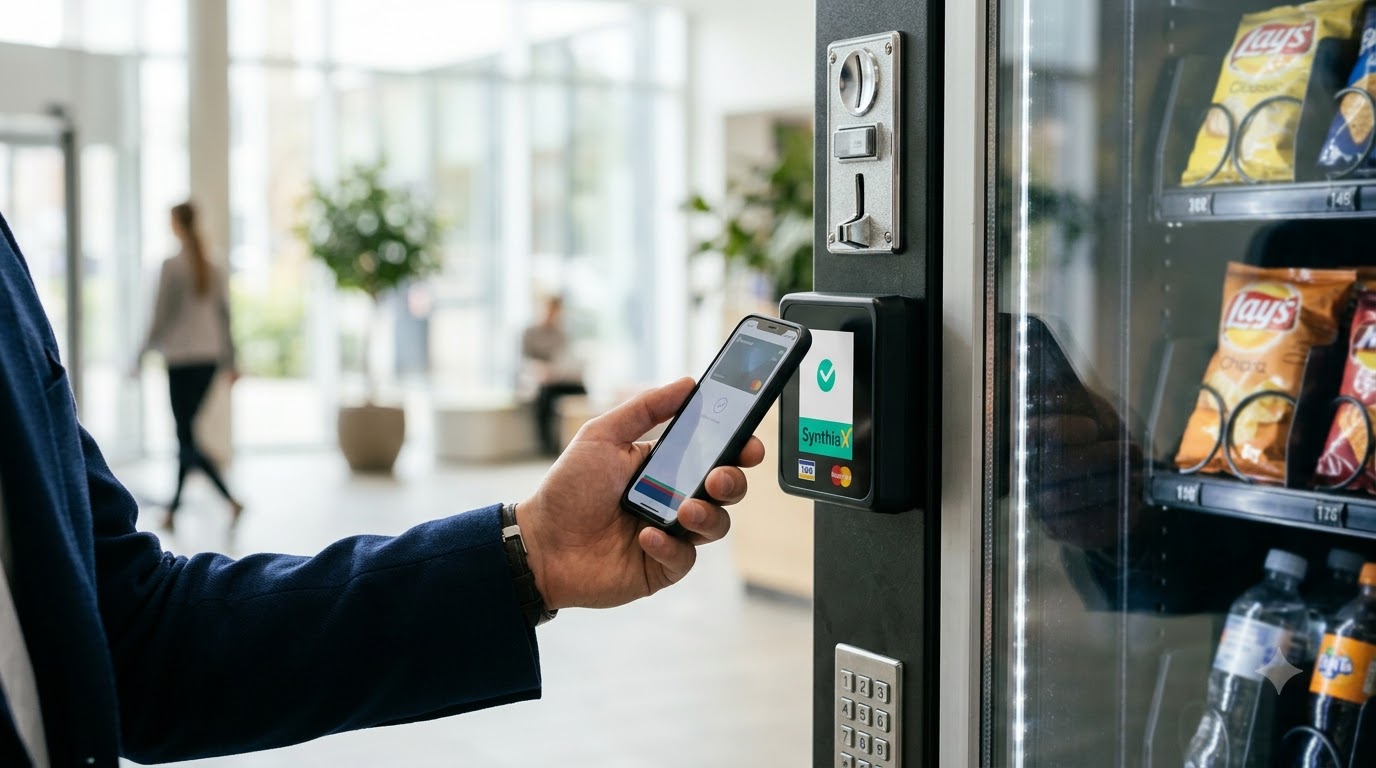
Short answer: Operators spend $160 to $400 upfront for vending card reader hardware, $5 to $15 per month for cellular telemetry software, and 1.2% to 5.95% per transaction in payment processing fees. While hardware prices grab attention at checkout, monthly subscriptions and processing rates determine your actual profit margins over time.
Consumers rarely carry loose change or bills anymore, so adding a credit card reader for vending machine units has become an essential revenue driver. Whether you manage one office snack machine or oversee dozens of beverage units, you need transparent pricing before buying. Below, we break down every expense, explain how to evaluate terminals, compare Nayax, Cantaloupe, and SynthiaX, and show why SynthiaX offers the best low-fee solution.
Credit Card Reader for Vending Machine Price: Full Cost Breakdown
Understanding your true financial commitment requires examining five distinct cost layers. Many new operators budget only for hardware and overlook recurring deductions during their first year.
1. Upfront Hardware Cost: $160 to $400+ per Unit
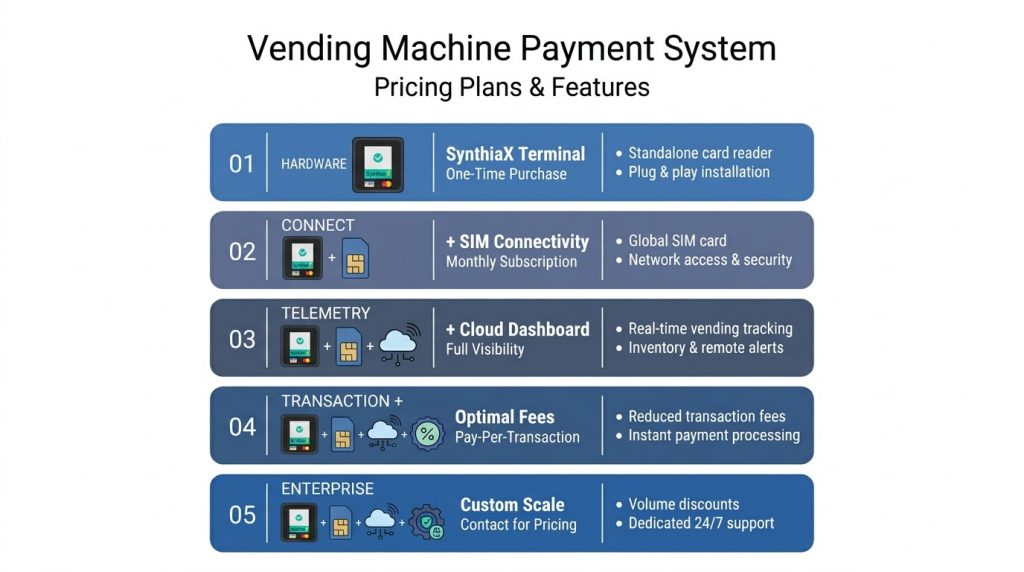
You pay a one-time price for the terminal, mounting bracket, and harness. Entry-level contactless readers run $160 to $200, while legacy touchscreen models cost $250 to $400 per machine. Volume orders cut per-unit costs. SynthiaX keeps upfront spend low by pricing SynthiaX-1 hardware around $160 to $200, or £140 to £185 depending on volume, saving operators capital.
2. Activation and Onboarding Fees: $0 to $50
Several legacy payment processors charge $25 to $50 per terminal to activate the SIM card and configure your merchant account. Operator-friendly platforms waive onboarding fees so you deploy machines faster.
3. Monthly Cellular and Telemetry Fees: $5 to $15 per Machine
Unattended card terminals transmit payment data over built-in 4G LTE modems rather than relying on unreliable venue Wi-Fi. Traditional vendors charge $9.95 to $15 monthly per machine for cellular data and cloud software. By contrast, SynthiaX keeps monthly overhead low at roughly $5 to $7 per device, bundling cellular connectivity, telemetry, and software updates.
4. Transaction Processing Fees: 1.2% to 5.95%
Every tap from Visa, Mastercard, Apple Pay, or Google Pay incurs a processing deduction. Because typical vending tickets average $1.50 to $3.50, fixed per-swipe surcharges quickly hurt margins. Legacy vending processors often charge 3.5% plus $0.20, or flat rates near 5.95% per vend. On a $2.00 drink, a 5.95% fee takes $0.12, and a $0.20 flat surcharge pushes costs past 15%. SynthiaX offers transparent processing starting as low as 1.2% plus interchange with zero hidden gateway fees, leaving more profit per vend.
5. Hidden Operational Expenses
Watch out for early contract termination penalties, ownership transfer fees on used readers, PCI compliance charges, and high-gain extension antennas costing $20 to $50 for basements or concrete garages.
| Cost Layer | Industry Average | SynthiaX Pricing |
| One-Time Hardware | $160 to $400+ | ~$160 to $200, or £140 to £185 |
| Activation Fee | $0 to $50 | $0 Direct Setup |
| Monthly SIM and Cloud | $8 to $15 monthly | ~$5 to $7 monthly |
| Processing Rate | 2.5% to 5.95% | From 1.2% + Interchange |
How to Find the Best Credit Card Reader for Vending Machine Setups
Choosing the right terminal depends on your machine age, foot traffic, and average item price. Evaluate these five practical criteria before buying.
- Verify Protocol Compatibility: Machines built after the mid-1990s typically use the Multi-Drop Bus, or MDB, standard. Confirm that your vending machine controller supports MDB, or check whether older hardware needs a pulse adapter or DEX connection. For legacy pulse fleets, bridges like SynthiaX CoreLink 16 connect up to 16 pulse units through one central payment terminal.
- Support Every Payment Method: Modern buyers expect instant tap-to-pay convenience. Pick a terminal that accepts EMV chip cards, contactless debit and credit cards, NFC mobile wallets like Apple Pay and Google Pay, and QR payments.
- Prioritize Cellular Reliability: Avoid terminals that depend on a host building’s Wi-Fi network, which drops offline and triggers IT delays. Select hardware with an integrated multi-carrier 4G LTE SIM card and external antenna support.
- Calculate Two-Year Total Cost: A cheap upfront reader loses value if a 5.95% fee drains revenue monthly. Combine hardware cost, monthly fees, and projected processing deductions across 24 months to see your real expense.
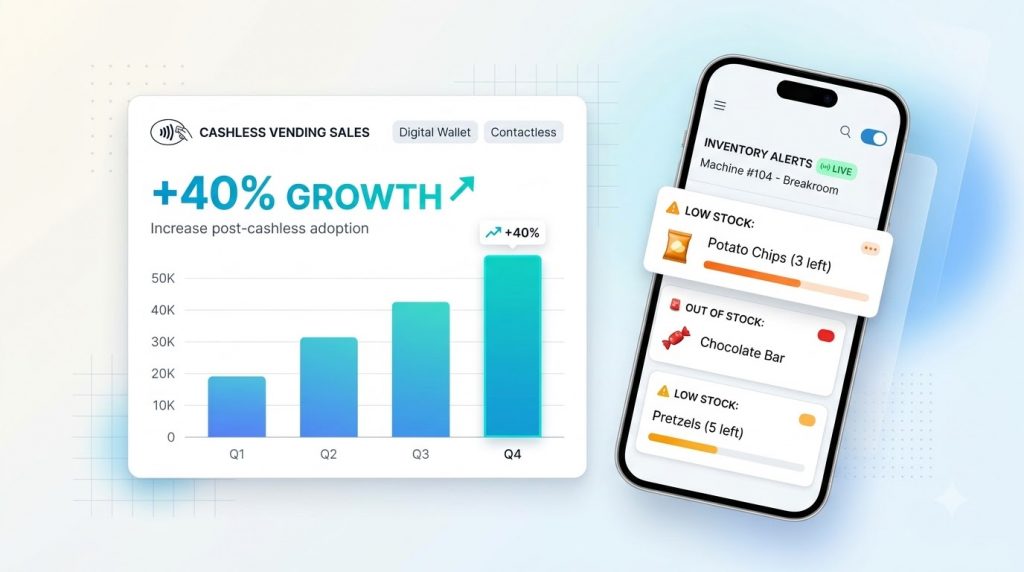
- Demand Live Telemetry and Fast Payouts: Quality readers track sales and machine health remotely. Pick a system that sends instant fault alerts, monitors coil-level stock, and deposits funds into your bank account within days rather than weeks.
Why Do You Need a Credit Card Reader for Your Vending Machine?
Relying solely on coins and dollar bills caps your revenue potential. Upgrading to cashless technology solves four core operational problems immediately.
- Unlock Cashless Impulse Sales: Fewer than 15% of consumers regularly carry physical cash for everyday snacks and drinks. Adding tap-to-pay options typically lifts gross machine sales by 25% to 40%.
- Grow Average Ticket Size: Exact change restricts what shoppers buy. Card and mobile wallet users regularly purchase multiple items or choose higher-priced drinks, raising average transaction values.
- Optimize Restocking Routes: Built-in telemetry shows exactly which items sold before you leave the warehouse. You eliminate wasted trips to full machines and plan efficient restocking routes.
- Cut Cash Handling Headaches: Coin jams, rejected bills, and heavy coin bags waste hours of labor weekly. Cashless payments send revenue directly into your bank account, reducing theft risk and maintenance calls.
Top 3 Card Readers: Nayax, Cantaloupe, and SynthiaX
Three brands dominate cashless vending comparisons. Here is how Nayax, Cantaloupe, and SynthiaX stack up on pricing, features, and long-term value.
1. Nayax VPOS Touch
Nayax ranks among the biggest global names in cashless vending. Its VPOS Touch features a 2.4-inch Gorilla Glass touchscreen, voice prompts, built-in telemetry, and support for EMV chip, swipe, NFC wallets, and QR codes.
- Pricing: Operators typically pay $220 to $350 upfront for hardware, around $30 for activation, $10 to $15 monthly for SIM and cloud access, and roughly 2.5% to 3.5% plus $0.10 to $0.20 per transaction depending on plan tier.
- Verdict: Nayax offers strong global coverage and a polished touchscreen, though higher monthly fees and slow ownership transfer queues frustrate smaller independent operators.
2. Cantaloupe ePort G11 and Engage Series
Cantaloupe, which rebranded from USA Technologies, serves major North American vending fleets. Both the ePort G11 and touchscreen Engage series pair 4G LTE connectivity with EMV contactless readers and deep integration into Cantaloupe’s VMS software.
- Pricing: Hardware usually runs $350 to $400+ per unit, monthly service fees start near $9.95 per device, and standard processing rates sit around 5.95% unless enterprise volume unlocks custom rates.
- Verdict: Cantaloupe works well for large enterprise fleets, but high hardware prices and steep standard transaction fees squeeze margins for growing operators.
3. SynthiaX and the SynthiaX-1 Payment Terminal
If expensive hardware and 5% transaction fees drain your profits, SynthiaX delivers the clearest, operator-first solution. SynthiaX engineered the weather-resistant SynthiaX-1 terminal to remove traditional vending bottlenecks, installing via plug-and-play MDB or pulse connections in under 30 minutes and accepting Visa, Mastercard, Apple Pay, Google Pay, and QR codes effortlessly.
- Pricing: Hardware starts around $160 to $200, or £140 to £185 depending on volume, monthly SIM and telemetry cost roughly $5 to $7 per unit, and processing starts as low as 1.2% plus interchange with zero hidden gateway fees.
- Why SynthiaX Wins: Beyond delivering ultra-low operating costs, SynthiaX pairs the SynthiaX-1 reader with Ardelino telemetry for live inventory alerts, Flair Card for closed-loop workplace cards, and CoreLink 16 to link up to 16 pulse machines to one terminal. You keep far more revenue per vend while managing your entire fleet from one dashboard.
| Feature / Metric | SynthiaX | Nayax | Cantaloupe |
| Primary Terminal Model | SynthiaX-1 Reader | VPOS Touch / Onyx | ePort Engage / G10-S |
| Hardware Acquisition Cost | Most Affordable | Moderate to High | High |
| Transaction Processing Fee | Lowest in the Market (1.6% with 0.6% for first 3 months ) | Standard Tiered Rate | Standard Tiered Rate |
| Monthly Telemetry / SaaS | Transparent Flat Rate £7/month | Higher Tiered Monthly Fee | Higher Monthly Contract Fee |
| Support Accessibility | 24/7 Rapid Live Support | Ticket System with Queue | Phone Support during Hours |
| Inventory & Telemetry Engine | Ardelino Telemetry System | Nayax Core / MoMa App | Seed Management Platform |
| Installation Simplicity | Plug-and-Play (under 10 – 30 min) | Moderate Configuration | Moderate to Complex |
Frequently Asked Questions
Does a vending card reader need site Wi-Fi?
No. Modern readers like the SynthiaX-1 include built-in 4G LTE cellular SIM cards. They connect automatically over mobile networks, eliminating venue Wi-Fi headaches.
Can older vending machines accept card readers?
Yes, if the control board supports MDB or pulse signals. Legacy equipment without native MDB ports connects easily using pulse adapters or SynthiaX’s CoreLink 16 controller.
How fast does a card reader pay for itself?
Most operators recover hardware costs within two to four months. Because cashless acceptance boosts total sales by 25% to 40% while cutting service trips, extra profits quickly cover your initial spend.
How quickly do funds reach my bank account?
Traditional processors often hold payouts for a week or enforce minimum balances. SynthiaX offers rapid settlement schedules so cash lands in your account quickly for restocking.
Can I deduct card reader fees on my taxes?
Yes. Equipment purchases, monthly cellular fees, and transaction charges qualify as standard business operating expenses. Speak with your accountant about claiming equipment and software deductions.
Can I still take cash after installing card reader?
Yes. you can still take cash and coins as usual even after installing a card reader. Card reader acts as a additional equipment and doesn’t change anything in your vending machines mechanism.
Upgrade Your Vending Fleet with SynthiaX Today
Every day you run cash-only machines or pay 5.95% legacy processing fees costs your business real margin. You do not need $400 terminals or restrictive multi-year contracts to accept modern payments. SynthiaX gives you the complete solution: affordable SynthiaX-1 hardware, 30-minute plug-and-play setup, live Ardelino telemetry, and low processing rates starting from 1.2%. Whether you operate one location or scale a 50-machine route, SynthiaX keeps more profit on every vend. Order a SynthiaX demo device today and start capturing every cashless sale.