

How to Go Cashless on Vending Machines: The Ultimate Operator Guide
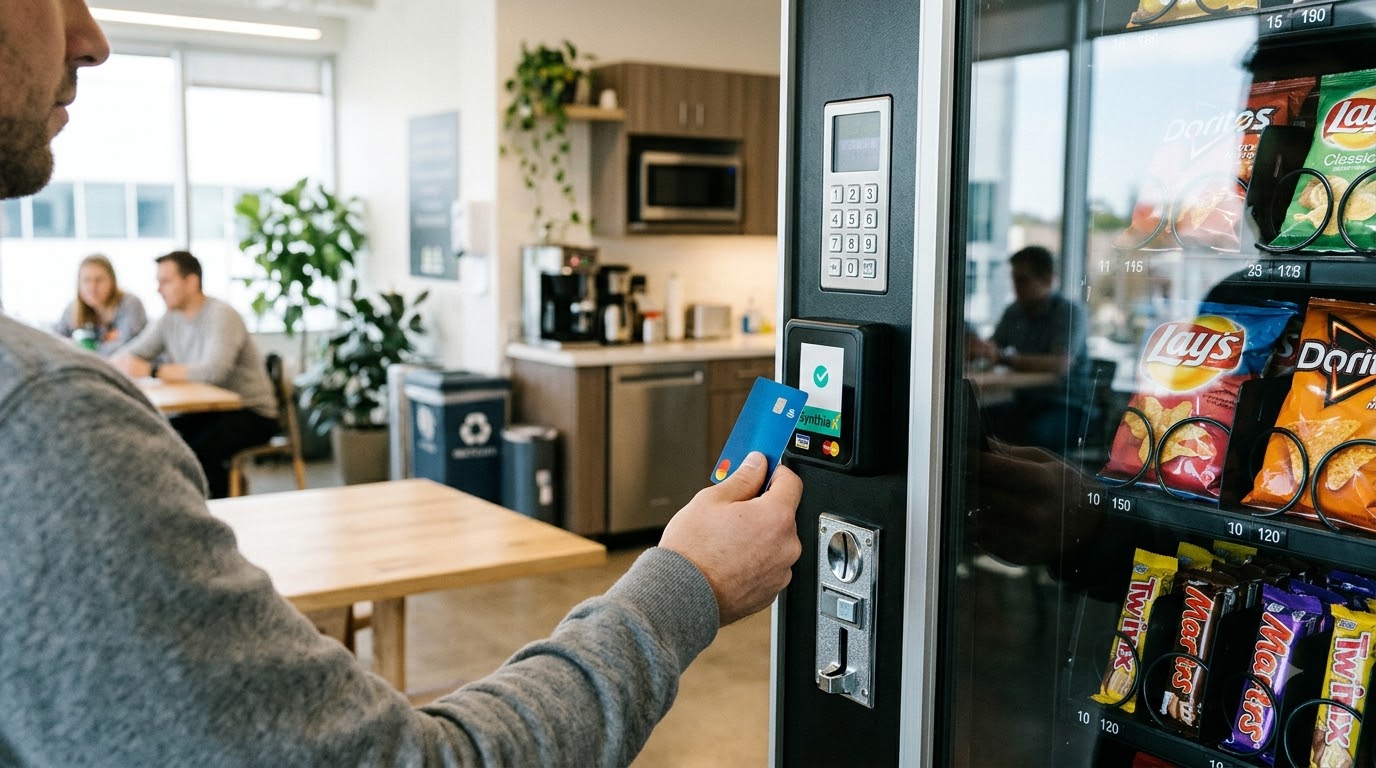
Vending machines that rely exclusively on coins and folded dollar bills are quickly fading from the modern retail landscape. Consumers today carry smartphones, contactless credit cards, and smartwatches, but they rarely carry physical currency. If your equipment only accepts coins and bills, you leave profitable transactions behind every single day. Modern automated retail demands speed, convenience, and frictionless checkout.
To go cashless on vending machines, confirm your machine supports standard MDB protocol, attach an unattended payment reader to your machine door, plug the reader into the MDB wiring harness, and activate a cellular telemetry data plan. Modern turnkey solutions such as SynthiaX allow you to install the hardware within thirty minutes, instantly enabling contactless debit cards, credit cards, Apple Pay, and Google Pay while streaming real-time inventory metrics to your dashboard.
When you go cashless on vending machines, you immediately eliminate the physical friction of exact change and unlock spontaneous impulse purchases. Whether you manage five snack units in local schools or fifty drink dispensers across office parks, modernizing your fleet protects your profit margins. If you plan to go cashless on vending machines, this comprehensive operational guide covers the exact installation steps, essential hardware requirements, key benefits, and leading terminal comparisons to help you succeed.
Step-by-Step Guide: How to Go Cashless on Vending Machines
Upgrading traditional automated retail equipment sounds complex, but manufacturers build modern unattended hardware for quick installation in the field. You do not need an engineering degree or custom fabrication skills to complete the upgrade. Follow these five direct steps to modernize your fleet.
Step 1: Verify Machine Compatibility
When you prepare to go cashless on vending machines, first inspect your machine control board. Your controller must support the Multi-Drop Bus (MDB) standard. MDB serves as the universal internal communication language that connects coin changers, bill validators, and card readers. Look inside your cabinet for a small harness featuring a white or black six-pin rectangular plug. If your equipment left the factory after the year 2000, it almost certainly features native MDB capabilities.
Step 2: Choose Your Cashless Hardware
Next, choose payment hardware designed to go cashless on vending machines reliably in all environments. You want a weather-resistant terminal that supports tap-to-pay cards, EMV chip contact, and near-field communication (NFC) wallets like Apple Pay. Forward-thinking operators choose SynthiaX as their primary solution because it combines compact payment terminals with built-in 4G LTE cellular connectivity and powerful telemetry at competitive operating rates.
Step 3: Mount the Terminal
Installing the physical reader to go cashless on vending machines takes less than thirty minutes on location. Most standard vending doors feature a factory knockout plate specifically intended for card readers. Remove this blank rectangular plate. Position your reader over the opening, slide the threaded studs through the mounting holes, and secure the nuts from inside the door using a standard nut driver. Run the antenna to the top exterior of your cabinet to ensure strong cellular reception.
Step 4: Connect the Wiring Harness
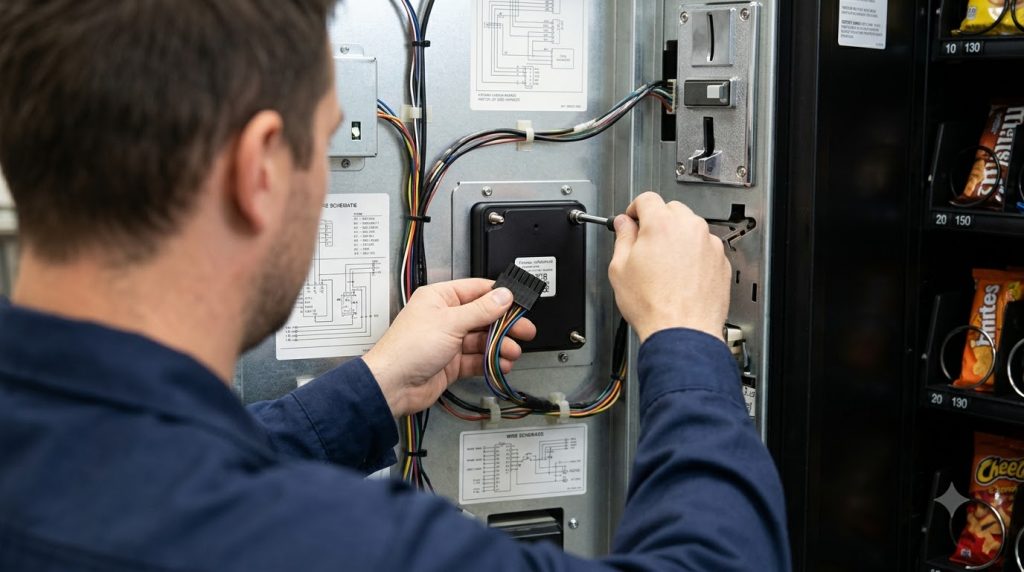
Turn off the main power switch before touching any internal electrical connections. Unplug the existing MDB harness connecting your coin mechanism and bill validator. Plug the card reader harness directly in line with these devices using the standard male-female pass-through connectors. If your unit supports Data Exchange (DEX), plug the DEX cable into your main control board to extract granular sales data. Once you seat all connections firmly, switch the power back on.
Step 5: Activate and Test
Your network activation ensures you go cashless on vending machines without transaction delays or dropped signals. Log in to your provider portal, link the reader serial number to your bank account, and initialize the SIM card. Perform a live test purchase with your personal contactless debit card before you go cashless on vending machines for the public. Check your vendor mobile app immediately to verify that the terminal recorded the sale correctly. Once you confirm authorization speed, you are ready to serve customers.
What All Is Needed to Go Cashless on Vending Machines
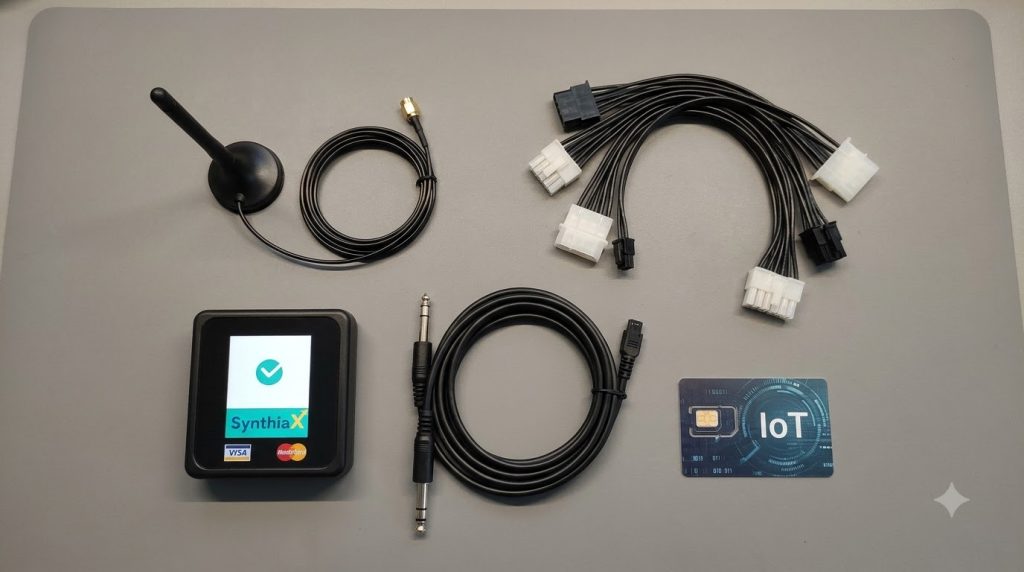
Gathering the necessary hardware to go cashless on vending machines requires only a few core physical and digital components. Preparing these parts ahead of time prevents route downtime and ensures your field installations proceed without interruption.
| Hardware / Component | Primary Function | Technical Specification |
| MDB Controller Board | Acts as the central computer managing internal communication | Standard MDB Level 2 or Level 3 protocol |
| Payment Terminal | Captures customer payments at the machine door | EMV Level 1 and 2, PCI-PTS, NFC-enabled |
| Telemetry Gateway | Transmits sales and diagnostic data to the cloud | Integrated 4G LTE Cat-M1 or NB-IoT modem |
| External Antenna | Ensures steady cellular connection through metal cabinets | High-gain magnetic mount omnidirectional antenna |
| Merchant Gateway Account | Deposits processed transactions into your business account | Automated clearing house (ACH) daily or weekly payout |
1. MDB-Compliant Vending Machine
A modern MDB harness allows you to go cashless on vending machines seamlessly by creating a shared electrical path between your coin mech, bill acceptor, and card reader. If you operate very old electro-mechanical units from the 1990s, you will need an MDB conversion kit or an upgraded logic board before you attach a card terminal.
2. Unattended Payment Terminal
The physical reader acts as the payment interface for your customer. Premium devices feature vivid color touchscreens, clear pricing prompts, and instant optical feedback. The reader must carry EMV Level 1 and Level 2 certifications, PCI-PTS security compliance, and support for major payment schemes like Visa, Mastercard, American Express, and mobile digital wallets.
3. Integrated Telemetry Modem and SIM Card
Real-time telemetry lets operators go cashless on vending machines while tracking inventory levels remotely. Your cashless reader houses an internal telemetry modem containing an active IoT SIM card. This dedicated cellular link transmits transaction authorizations to payment processors within seconds, bypassing the need for local building Wi-Fi networks.
4. Merchant Gateway and Management Software
An active merchant gateway enables you to go cashless on vending machines across all debit and credit networks. This cloud platform acts as the bridge between your machine, the acquiring bank, and your business checking account. Premium platforms also include full vending management systems that generate route pre-kitting lists, track mechanical error alerts, and summarize gross revenue.
5. Standard Mounting Hardware
Do not overlook basic shop tools. You will need a socket driver set, cable zip ties to keep internal wiring clear of vending delivery spirals, and occasionally a stepped drill bit if you are retrofitting a specialty cabinet that lacks a pre-punched card reader slot.
Key Advantages When You Go Cashless on Vending Machines
Upgrading your payment hardware delivers immediate returns that extend far beyond simple customer convenience. The operational advantages reshape your daily route productivity and strengthen bottom-line profitability.
| Advantage Category | Traditional Cash Operation | Cashless-Enabled Operation |
| Sales Volume | Restricted to loose coins and single bills | Captures high-ticket items and multi-vend buys |
| Route Management | Blind route driving and manual inventory counts | Remote pre-kitting and real-time restock alerts |
| Security Risk | High risk of cabinet break-ins and cash shrinkage | Zero cash temptation with fully digital tracking |
| Pricing Control | Rigid pricing rounded to the nearest nickel or dime | Flexible penny-accurate pricing and dynamic markups |
Substantial Sales Lift and Impulse Spending
Operators who go cashless on vending machines consistently report a twenty-five to forty percent lift in gross machine sales. Cash forces customers to calculate their pocket change before making a purchase. In contrast, contactless cards and smart devices remove psychological spending barriers. Customers routinely make multi-vend purchases, buying a snack and a drink together simply because tapping a card takes less than two seconds.
Lower Operational Costs and Reduced Labor
Route drivers save substantial time when you go cashless on vending machines across your entire territory. Technicians spend hours counting nickels, sorting dollar bills, clearing coin jams, and restocking change tubes. When electronic payments dominate your machine transactions, cash collection cycles stretch from weekly visits to monthly visits. Your staff spends less time sorting cash in the warehouse and more time placing new machines.
Superior Security and Loss Prevention
Physical cash inside an unattended machine represents an obvious target for vandalism and internal theft. You minimize vandalism and shrinkage when you go cashless on vending machines because thieves quickly realize the unit holds little to no physical currency. Furthermore, digital transaction records provide ironclad accounting transparency, eliminating discrepancies between inventory sold and cash collected.
Granular Analytics and Route Optimization
Automated sales logs prove invaluable once you go cashless on vending machines equipped with DEX telemetry. Instead of driving to a remote machine to discover what sold out, you check your phone dashboard over breakfast. You pack precisely the inventory items you need for the route, a process known as pre-kitting, reducing vehicle fuel burn and eliminating wasted trips.
Hardware Comparison: SynthiaX, Nayax, and Cantaloupe
Selecting the hardware you use to go cashless on vending machines affects your gross margins every single day. Payment terminal hardware costs, monthly SaaS connectivity subscriptions, and credit card processing fees differ significantly among leading vendors.
Below is an honest, side-by-side comparison of the three primary players in the unattended payment space: SynthiaX, Nayax, and Cantaloupe.
| Feature / Metric | SynthiaX | Nayax | Cantaloupe |
| Primary Terminal Model | SynthiaX-1 Reader | VPOS Touch / Onyx | ePort Engage / G10-S |
| Hardware Acquisition Cost | Most Affordable | Moderate to High | High |
| Transaction Processing Fee | Lowest in the Market (1.6% with 0.6% for first 3 months ) | Standard Tiered Rate | Standard Tiered Rate |
| Monthly Telemetry / SaaS | Transparent Flat Rate £7/month | Higher Tiered Monthly Fee | Higher Monthly Contract Fee |
| Support Accessibility | 24/7 Rapid Live Support | Ticket System with Queue | Phone Support during Hours |
| Inventory & Telemetry Engine | Ardelino Telemetry System | Nayax Core / MoMa App | Seed Management Platform |
| Installation Simplicity | Plug-and-Play (under 30 min) | Moderate Configuration | Moderate to Complex |
SynthiaX: The Modern, High-Margin Solution
SynthiaX stands out as the ultimate solution to go cashless on vending machines for operators who prioritize high reliability, clear pricing, and technical simplicity.
Unlike legacy providers that lock operators into confusing fee structures, SynthiaX delivers transparent pricing, the lowest payment processing fees in the sector, and highly competitive terminal purchase rates. The flagship SynthiaX unattended terminal features ultra-fast 4G LTE processing, MDB and pulse support, and complete integration with the Ardelino telemetry engine.
Operators access live sales tracking, automated stock depletion alerts, remote pricing adjustments, and smart route planning in one consolidated dashboard. Furthermore, SynthiaX backs its platform with dedicated 24/7 technical assistance through direct channels like WhatsApp and phone, ensuring customer inquiries receive responses in under one hour. For operators eager to protect their margin on every single vend, SynthiaX represents the premier market choice.
Nayax: The Legacy Global Provider
Nayax remains one of the oldest and most recognizable brands in unattended payments. Their primary units, including the VPOS Touch and Onyx readers, handle all global payment forms and offer solid cellular coverage.
While Nayax delivers established terminals to go cashless on vending machines, high recurring costs eat profits. Operators frequently encounter setup charges, complex tiered transaction percentages with fixed per-vend surcharges, and monthly software maintenance fees that accumulate quickly across large routes. Additionally, many operators report lengthy wait times when attempting to reach customer support for deactivated SIM cards or hardware faults.
Cantaloupe: The Traditional Enterprise Giant
Cantaloupe commands deep market penetration across the unattended retail market with its ePort series and Seed software suite. Their hardware functions reliably and connects easily to traditional machines.
Cantaloupe offers another route to go cashless on vending machines, yet its setup remains rigid. The hardware units often cost more upfront, and the Seed enterprise telemetry platform can prove unnecessarily complicated and costly for small-to-midsize operators. Contract terms are often inflexible, and monthly gateway charges cut into the margins of lower-volume machines.
Frequently Asked Questions
How much capital do I need to go cashless on vending machines?
The average upfront cost for an unattended payment reader ranges between $150 and $450 depending on the manufacturer and screen type. In addition, plan for a monthly cellular and software connectivity fee between $5 and $12 per machine, alongside standard credit card processing rates averaging between 2% and 5% per transaction. SynthiaX significantly lowers these barriers by offering budget-conscious hardware and the lowest processing fees available in the sector.
Can older vending machines work with card readers?
Yes, provided the machine possesses an MDB-compatible control board. Machines manufactured after 2000 usually include MDB ports right out of the factory. If your machine runs on an older non-MDB pulse system, you can easily install an aftermarket MDB upgrade kit or universal controller board to establish compatibility before you mount your reader.
Do I need a local Wi-Fi router to go cashless on vending machines?
No. Commercial card readers feature integrated cellular modems equipped with dedicated IoT SIM cards. The reader connects automatically to the strongest regional 4G LTE cellular carrier, ensuring secure transaction authorization without touching local building Wi-Fi networks.
Do I need to remove the coin mechanism to use a card reader?
No. You don’t need to remove your coin mechanism to use a SynthiaX card reader, you keep you coin accepting mechanism, card reader just comes in as a add on to increase you sales. Vending machines with MDB compatibility come with extra wires to attach a card reader while keeping the coin mechanism the same.
What happens if the cellular signal drops temporarily?
Leading card readers feature offline storage processing or intelligent reconnect capabilities. If a cellular network dips momentarily, the terminal attempts immediate reconnect protocols. When paired with high-gain magnetic antennas mounted outside the metal cabinet, your terminal maintains uninterrupted connectivity even in basement hallways and hospital alcoves.
Ready to Go Cashless on Vending Machines
Modern consumers demand swift, tap-and-go convenience wherever they shop, and automated retail is no exception. Holding onto cash-only payment boxes caps your revenue potential, burns driver hours on manual coin counting, and blinds you to daily inventory changes.
Modernize your fleet today and go cashless on vending machines with zero guesswork. SynthiaX delivers the ideal combination of affordable terminal hardware, low transaction rates, integrated Ardelino telemetry, and rapid technical support. Upgrade your machines, capture every impulse vend, and accelerate your business growth by partnering with SynthiaX. Contact SynthiaX now to request your demo device and elevate your vending route today.